
BATTLE OF MAUCHLINE MUIR MEMORIAL
The political and religious troubles of the mid seventeenth century saw the Covenanters at odds with King Charles I, who claimed that he was the head of the church, and had control over it. At the time of the battle, he had been deposed, and the country was run by the Protectorate, which had formed an Engagement.
This was an agreement signed at Carisbrooke Castle on the Isle of Wight between the moderate Covenanters and the King, in which they agreed to support the king in return for him to accept Presbyterianism in Scotland, and try it out in England for a period of three years.
In Ayrshire many ministers opposed this, and built up a considerable following. In addition to standing against the Engagement, they also were very much against the protectorate’s levy on the people to pay for the wars of the period.
The minister planned a communion service to be held in Mauchline on 11 June 1648 and large numbers came to take part. Many of these were armed, though it is not known if this was planned, encouraged by the ministers, or whether it was a spontaneous rising. The supporters were without a leader, however, for they had met in Kilmarnock the day before and decided against rising against the authorities.
Seven ministers were present that day. They were Rev William Adair (Ayr), Rev Alexander Blair (Galston), Rev William Guthrie (Irvine), Rev Gabriel Maxwell (Dundonald), Rev Matthew Mowat (Kilmarnock), Rev John Nevay (Loudoun), and Rev Thomas Wyllie (Mauchline). They gathered together a force of two thousand supporters, who made their way from Kilmarnock to Mauchline. The number had gathered from far and wide, though most of the men were from Ayrshire and Lanarkshire. Many of the Lanarkshire men had attended in order to avoid a levy that was being collected by the soldiers in order to fund a rising on behalf of the king.
At Mauchline, the vast numbers under the ministers held a communion service out in the open muir. As far as the authorities were concerned, this service was bad enough, but they were particularly disturbed at the fact that the communicants were armed with swords.
The Covenanters were anticipating further support to come from Argyll and Fife, where their number was strong, but this did not materialise. Disappointed at the failure of the support to turn up, the Covenanters on the muir decided to disperse and make their way home.
Just as this was about to happen, the Commonwealth soldiers attacked. The troops under the Earl of Middleton and Colonel James Turner had made their way to Mauchline to investigate the large numbers meeting there, anticipating some form of revolt. They had six troops of horse and a further troop was following on behind, led by the Earl of Callendar.
The ministers on the Covenanting side advised the two thousand supporters to scatter, for their own safety. They also negotiated with Middleton for an hour before the attack came. Although his force was six hundred cavalry strong, he only ordered part of his men forward. These men were forced back by the 2,000 Covenanters lined up against them, of which 1,200 were horsemen. Callander’s men joined those who had been repelled, adding to their number, and making them more able to face the Covenanters.
A second attack was more forceful and had more success. A short battle ensued, with casualties on both sides. The Covenanters now turned around and fled. At first Middleton ordered his men not to kill, but some claim that this was only shouted for the benefit of the ministers’ hearing, and not for his soldiers.
The Earl of Middleton was injured in the affray. He received a wound to the head, and it is also reported that he was injured on his back as he fled the field, pursued by a blacksmith.
Another important figure who received wounds from the Mauchline Covenanters was Sir John Hurry. He was originally a supporter of the Covenanters but changed sides, supporting Montrose and the Royalists. He was captured after the Battle of Carbisdale and beheaded in 1650. Like Middleton, he was wounded to the head. With Middleton and Hurry injured, Callander’s reinforcements arrived, adding to the soldiers already there, decisively repelling the Covenanters.
One of the contemporary accounts of the battle was written by the Mauchline minister, Rev Thomas Wyllie. He tells of the soldiers pursuing the Covenanters as they fled south towards Barskimming. As the Covenanters came towards the River Ayr, at the large bend in the river at Airds Holm, they found themselves trapped by the water – they would have to either turn and fight or drown. Apparently, they turned and forced their pursuers back a mile and a half towards Mauchline yard dikes, that is the walls at the back of the gardens in the village.
Wyllie also relates a story whereby one of the soldiers pursed a Covenanter towards Barskimming Bridge. The Covenanter, probably a local, did not cross the bridge but fled to the steep rocky bank on the north side of the river, downstream from the bridge. There he climbed down and hid himself on a rock shelf, hanging onto a tree root to prevent him from falling into the river. The trooper in pursuit was less lucky, for he was riding so fast that he fell headlong over the precipice into the river below, drowning in the water.
The battle did not last long, both sides making a tactical retreat. The number of dead is reckoned to be around 30-40, evenly split on both sides. Turner claims that only ten or so Covenanters were killed. It is reckoned that most of the Covenanters fled to the hills of southern Ayrshire and into Galloway. Interestingly, there is no history or tradition as to where the dead bodies were buried.
About sixty of the Covenanting rebels and five officers were taken prisoner on the battlefield and transported to Ayr. They were imprisoned in the tolbooth and council house in the Sandgate. Indeed, so many were held prisoner that the council of Ayr had to meet in the provost’s house. A court martial was arranged for their trial, James Turner being the president. The sixty ‘country people’ were pardoned and allowed to go free. The officers were tried, found guilty, and sentenced to death, but they were eventually pardoned, the authorities reckoning that leniency would prevent further revolt. These officers were expected to sign a confession and oath supporting the parliament in implementing the Engagement on 19 June 1648.
The ministers present at the battle were also captured, but they were to be released the following day. The General Assembly of the Church of Scotland summoned the ministers who were active at Mauchline to appear before it in July 1648, but only four turned up. They informed the Assembly that ‘they had not actually forced the people to protest that day.’ They were examined for some time, eventually being sent away after some weeks.
Mauchline’s minister, Rev Thomas Wyllie, left the parish around 1655 and became the minister at Kirkcudbright. He remained strong in his support for the Covenanters, and in 1662, at the Restoration of Charles II he refused to accept him as head of the church and was thrown out of his parish. He was prevented from preaching for ten years, until in 1672 he was granted permission to return to the church. In that year he became minister at Fenwick. He died in 1676.
Battle of Mauchline Muir Memorial
Mauchline Cemetery
Barskimming Road
Mauchline
Ayrshire
NGR - NS 495264
The memorial is located just within the main gate of Mauchline Cemetery. This is located south of the village, beyond the railway line, on Barskimming Road (off Loudoun Street).
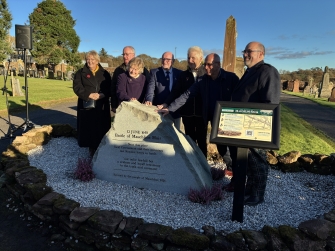
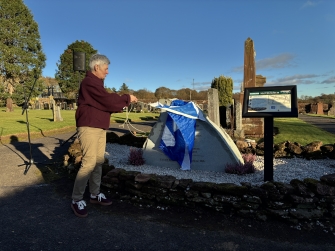
The monument was officially unveiled on Sunday 1 November 2026 by Lillian Jones MP. Funding for the memorial came from the Pride in Place fund, with additional support from Mauchline Community Council, East Ayrshire Council, Kays of Scotland, Galloway Stone, Ayrshire Signs, Russell Wyllie and Rev Allan Vint, minister of Mauchline and Sorn.
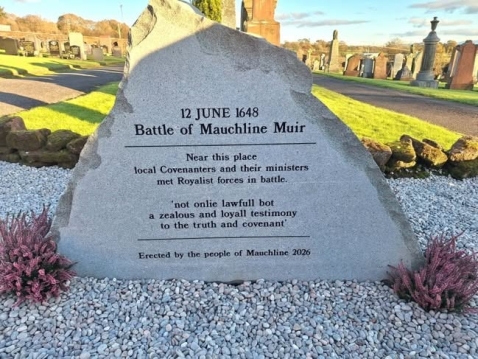
12 JUNE 1648
Battle of Mauchline Muir
Near this place
local Covenanters and their ministers
met Royalist forces in battle
'not onlie lawfull bot
a zealous and loyall testimony
to the truth and covenant'
Erected by the people of Mauchline 2026
The memorial comprises of a large block of granite that came from Ailsa Craig and which was donated by Kays of Mauchline, manufacturer of curling stones. The stone was cut and inscribed by Galloway Stone.
| Visitor Counter: | |||||||
 |  |  |  | | | ||